Who You Going Call? Ghost Crabs Along the Jersey Shore.
It was the Sunday before Memorial Day weekend. A beautifully warm, humid, partly sunny day was making it feel more like summer on a spring day.
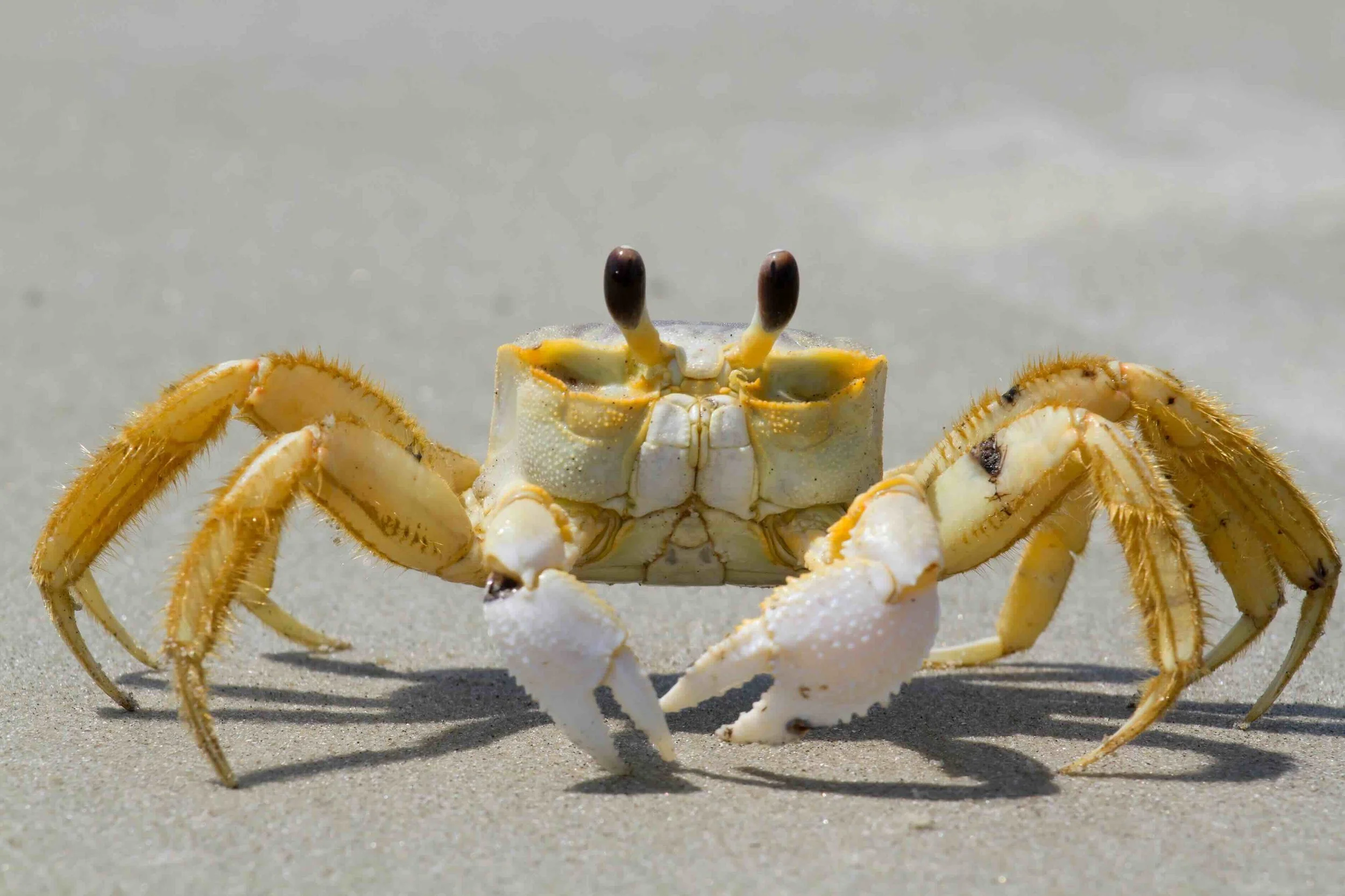
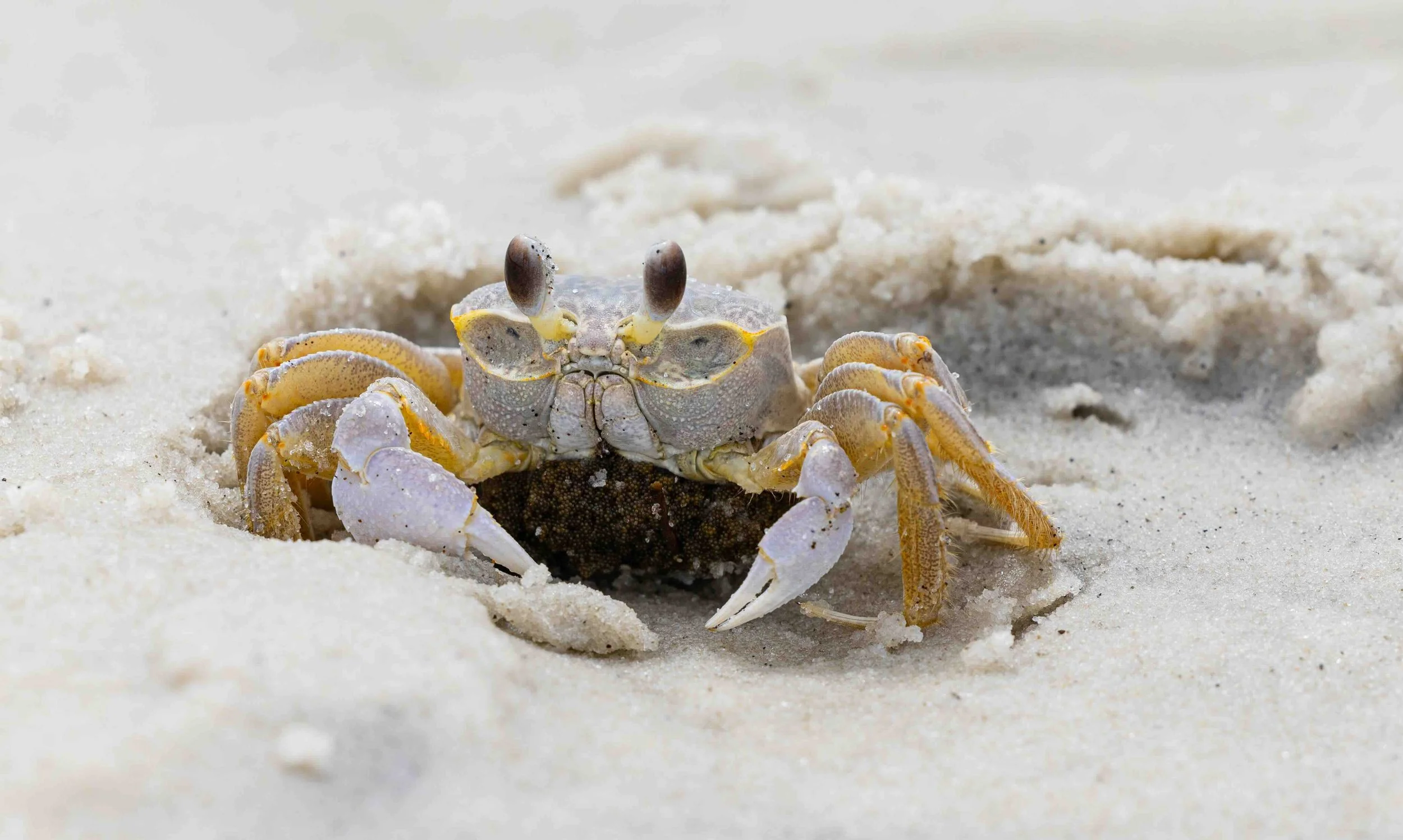
An adult Atlantic ghost crab (Ocypode quadrata).
Along the edge of the Atlantic Ocean, I was conducting a beach walk in Long Branch, NJ with about two-dozen people. We were walking along the shore during low tide looking for shells and other interesting beach finds. Everything seemed to be alive and in-motion, with evidence of life everywhere, including from imperiled animal populations due to habitat loss from coastal development. Forked-tailed least terns (Sternula antillarum), listed as an endangered species in New Jersey, were flying above the ocean looking for small fish to feed their young. A pair of distinctive black and white American oystercatchers (Haematopus palliates), listed as a "species of special concern" in New Jersey, were foraging nearby on newly washed-up blue mussels with their long, bright orange beaks. Not far were also a few lucky fishermen catching striped bass (Morone saxatilis) and bluefish (Pomatomus saltatrix) in the surf. The fish were following a large school of Atlantic menhaden or bunker (Brevoortia tyrannus) along the coast. Both striped bass and bluefish rely heavily on menhaden as a primary food source, with menhaden making up around 30% or more of their diet, particularly for fish over 25 inches.
Suddenly someone shouted for to me to look over by the edge of the sand dunes. With the sum in my eyes, I couldn’t see what the person was pointing at first. Was it a strange shell or maybe an unfamiliar bird? Then as I got a little closer, I could see the outline of a sand-colored crustacean with six yellowish legs and a square shaped body. With binoculars, I quickly recognized this pale yellowish-white crab as an Atlantic ghost crab (Ocypode quadrata).
Ghost crabs are mysterious and unusual sand crabs. They are not always easy to see by a causal beach walker. The crabs are renowned as one of the fastest land crabs, capable of reaching speeds up to 10mph, earning them the nickname "swift-footed" (Ocypode) for their rapid scurrying on sandy beaches to escape predators like gulls, owls and herons. A remarkable activity I think for an animal that walks sideways.
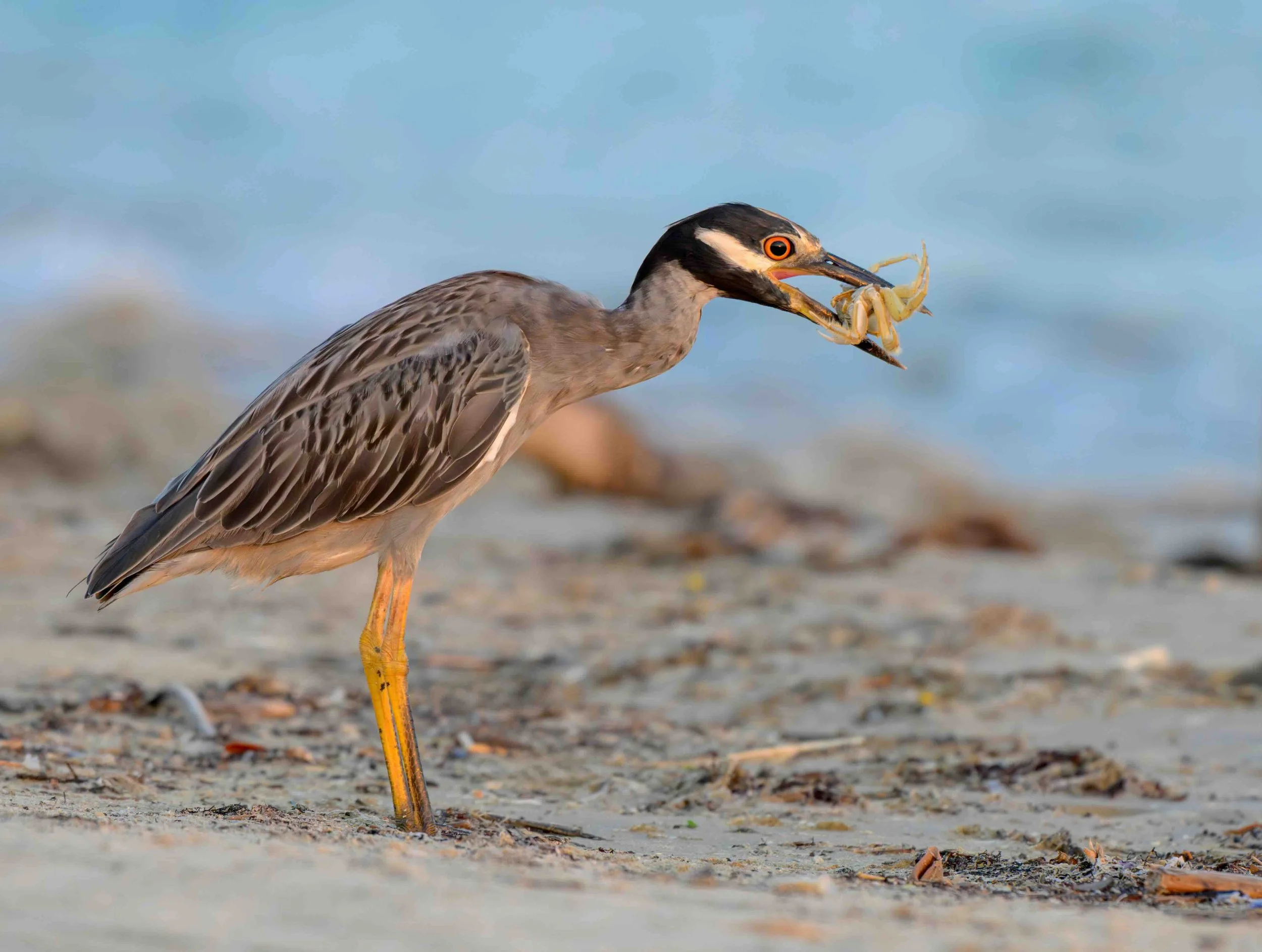
An adult Yellow-crowned night heron (Nyctanassa violacea) eating an adult Atlantic ghost crab.
Atlantic ghost crabs are named for both the ability to blend in with their seashore surroundings and for their mostly nocturnal behaviors. Their pale color helps them blend in with the sand, making them seem to "disappear" or move like ghosts.
Ghost crabs become most active at night to hunt for food on a sandy beach including insects, small clams, including coquina clams, mole crabs, and even dead fish and vegetation. The crabs are opportunistic predators and will sometimes consume the eggs and chicks of shorebirds, such as piping plovers, or even tiny sea turtle hatchlings. The crabs can be a significant, often overlooked, threat to nesting success for shorebirds and sea turtles, capable of raiding nests and disturbing nesting success.
As a child growing up along the Jersey Shore during the 1970s, I never encountered ghost crabs. The population was small in New Jersey and mostly located in Cape May County. When my parents took me on vacation to the Outer Banks of North Carolina is where I would first discovered ghost crabs. With a flashlight in hand, my mom would take me down to the edge of the ocean at night where I would see the crabs quickly scurrying. I might have screamed at first sight, as I was startled to see these large crabs moving around me, as I am sure they were equally surprised to see me and my flashlight. The crabs, as large as three inches wide, would disappear, seemingly vanishing into the sand, only to quickly sneak past me a few moments later in an unforgettable nocturnal dance.
As a child of 70s, the range for Atlantic ghost crabs was typically from the mid-Atlantic and subtropical areas of the United States. About Atlantic City, NJ to Florida. Today, the crabs are expanding their range and population into previously unoccupied northern latitudes from the northern Jersey Shore and up to New England. The expansion is likely due to warming ocean temperatures caused by climate change.
An August 2024 scientific study written by Mikayka N. Call and others from the Virgina Department of Fish and Wildlife tell us that the Atlantic ghost crab population is increasing along the East Coast “due to rapid, climate-driven change within coastal ecosystems.” The northern expansion for adult populations is generally to Rhode Island and Nantucket now, but ghost crab larvae have been found as far north as Woods Hole, MA. While no adults have been found at this latitude in Cape Cod, most likely due to cooler ambient air temperatures that are unfavorable for growth, it is only a matter of time before adult crabs appear scurrying on Cape Cod beaches. Ghost crabs prefer air temperatures generally higher than 56 degrees F.
How did the expansion of ghost crabs happen? It has to do with biology and breeding. Ghost crabs begin their life cycle in the ocean. Adult females will scurry to the water's edge at night and let waves wash over them to release their eggs into the surf zone where tides and currents then carry the eggs farther out into the ocean. It not as easy as it sounds though. The females need to be careful. A big wave could drown or suffocate them underwater.
The larvae develop in ocean waters for about six weeks, though the exact timing depends heavily on water temperatures. They drift with currents to generally different beaches from where they were originally released before the larvae develop enough to wash ashore as tiny crabs. With warming ocean temperatures, characteristic southern species including ghost crabs are expanding into previously cooler northern waters and beaches.
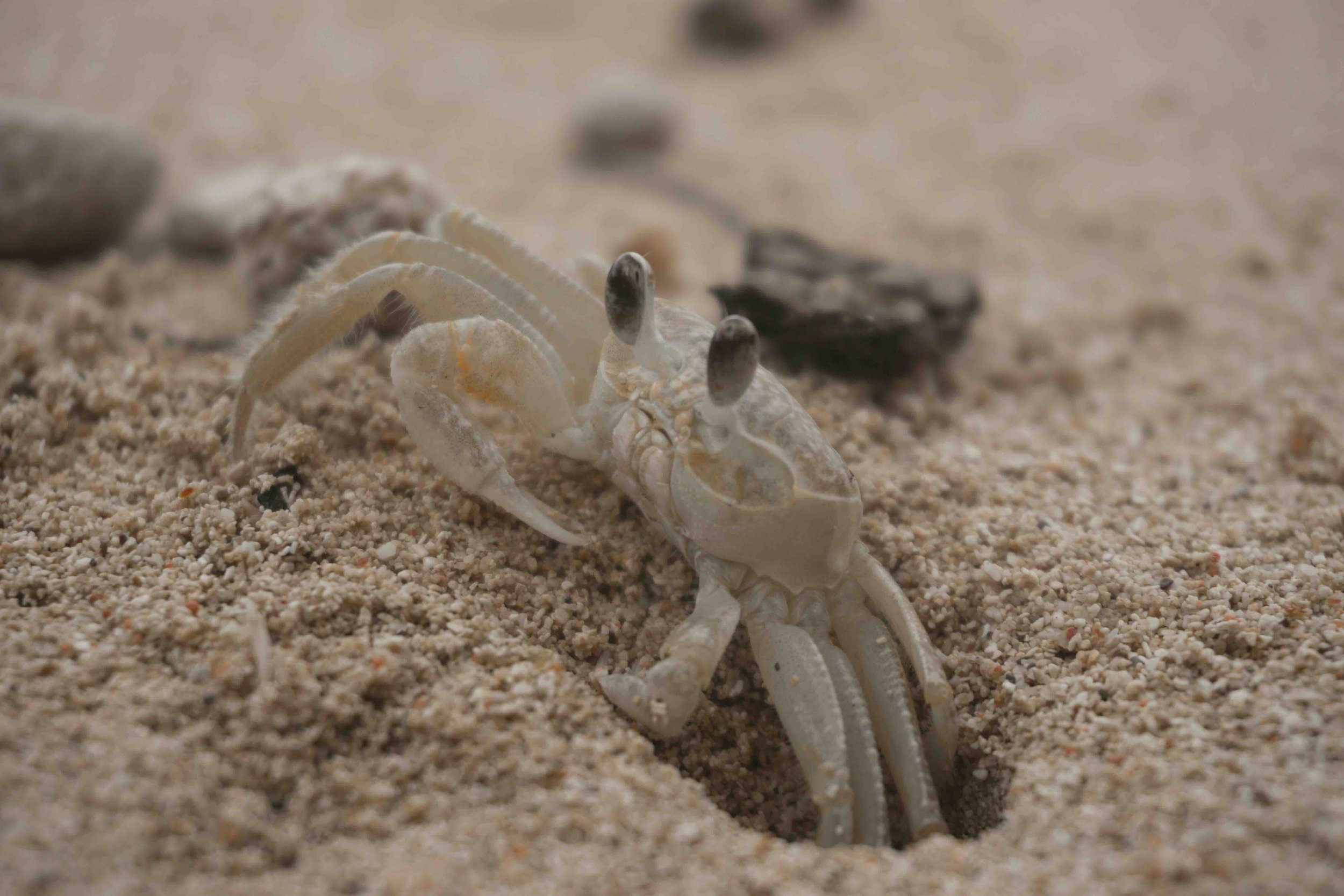
A juvenile Atlantic ghost crab at the entrance to its burrow near the ocean.
“The Atlantic Ocean in the northeast has warmed by about 2 degrees Fahrenheit over the last 15 years, much faster than the global average,” stated Malin Pinsky, a professor in the Department of Ecology, Evolution, and Natural Resources at Rutgers University in an August 12, 2024 article at NJ.com. The entire East Coast is seeing temperatures rise roughly 3.5°F in 30 years, causing fish and other aquatic species to move north. The expansion of ghost crabs, however, is more noteworthy than a typical fish I think because these crabs are ordinarily terrestrial and the expansion is due to floating larvae.
During the day, ghost crabs will spend most of their time living in deep burrows, often reaching 3 to 4 feet and extending down to the water table for moisture and refuge from heat, with angled entrances for ventilation according to sources from the South Carolina Department of Natural Resources. The crabs typically remain hidden in their burrows to avoid predators, like gulls, and the midday heat that can dry out their gills.
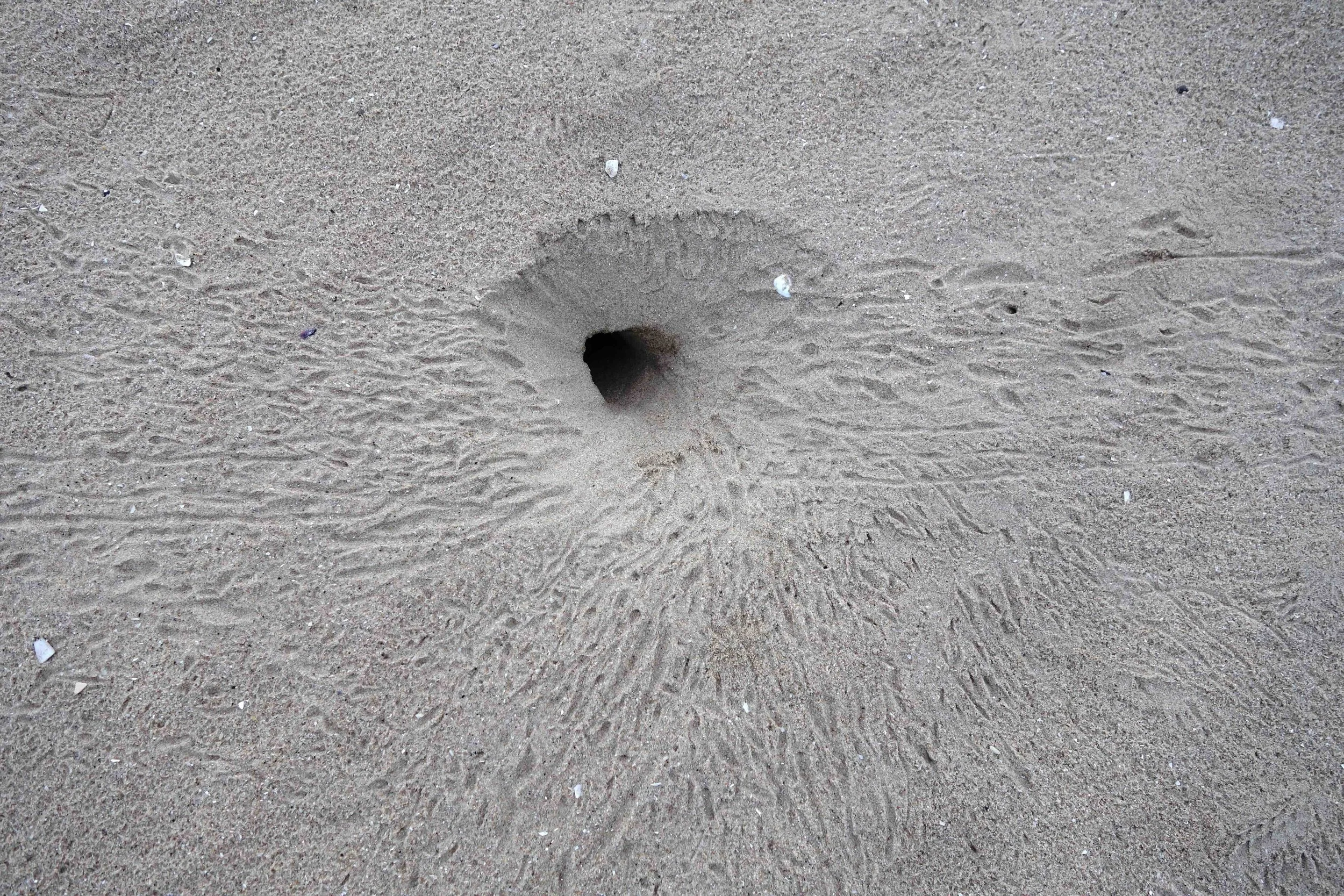
Atlantic ghost crabs can dig remarkably deep, complex burrows that can extend 3 or 4 feet into the sand. These, usually 1-to-2-inch wide, tunnels provide protection from harsh sun, predators, and winter temperatures, often located from the shoreline to 400 meters or 1,312.34 feet inland
Scientifically, ghost crabs are considered semi-terrestrial though, because they must periodically return to the edge of the ocean to keep their gills wet and for females to release eggs. It’s a balancing act. Ghost crabs need to keep their gills wet but can't stay in the water too long, as they can drown. In response, the crabs have adapted to also use fine hairs (setae) at the base of their walking legs that act like tiny straws to draw water up from damp sand through capillary action.
All this activity makes them masters of the intertidal zone - well-adapted to land but still dependent on the ocean.
Ghost crabs are also important and effective bio-indicator species for assessing the ecological health and human impact on sandy beach ecosystems. Their population density, burrowing behavior, and size distribution respond significantly to anthropogenic stressors like beach cleaning, urbanization, and tourism. As both predators and scavengers, they serve as crucial and easily monitored indicators of coastal food chain integrity and a low-cost method to measure the "health" of coastal environments. Let’s face it, the crabs have a very diverse diet, and if a beach can’t support a rich and diverse food supply, not much can survive either.
In addition, their habitat shifts northward can indicate impacts of sea-level rise and increased global warming activity. Ghost crabs are expanding their range poleward in the Atlantic Ocean, directly correlating with warming sea temperatures. For a little crab, there is a lot going on.
As Bill Murray’s character, Dr. Peter Venkman, famously said in the 1984 movie Ghost Busters, “Generally, you don't see that kind of behavior in a major appliance." I would also add until recently the Jersey Shore. But don’t let a little mysterious crab stop you from enjoying the beach. Get out and enjoy the coast! Maybe if you’re lucky you will get a new experience by seeing a ghost crab and expand your understanding of nature while having fun.
Sources:
Atlantic Ghost Crab: Ocypode quadrata, by David Knott and edited by Peter Kingsley, South Carolina Department of Natural Resources, 2013.
Biotic and abiotic factors affecting Atlantic ghost crab (Ocypode quadrata) spatiotemporal activity at an important shorebird nesting site in Virginia, by Mikayla N. Call and others, Department of Fish and Wildlife Conservation, Virginia Tech, Blacksburg, Virginia, United States of America. Published August 2024.
Crabs: A Natural History by Peter J.F. Davie, Princeton University Press 2021
Jersey Shore is seeing a rapid rise in ocean temps: Scientists say we should all be alarmed. By Steven Rodas, NJ Advance Media for NJ.com. Published July 23, 2024.
The Ghost Crab by Lorus J. Milne. Published in The Atlantic magazine, July 1946 issue